The Japanese Art of Kusozu Is Rooted in
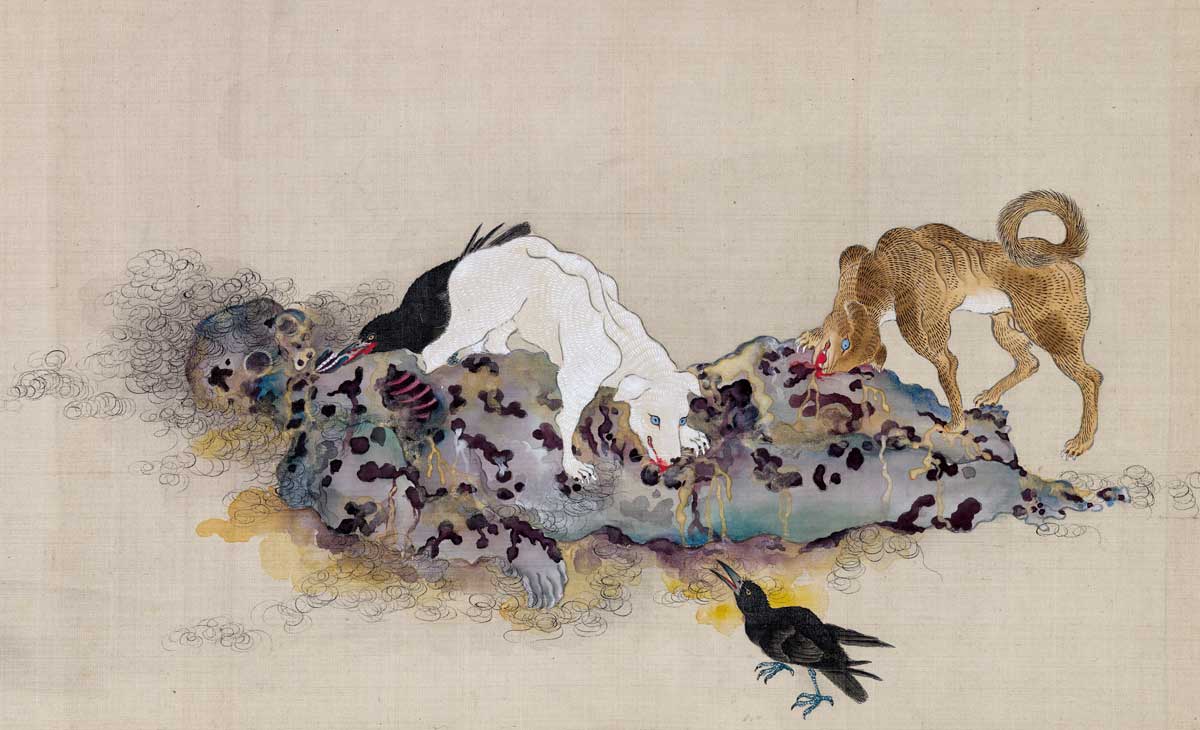
Art is often used to limited how different cultures perceive the inevitability of death and to try to make sense of what happens afterward we die. With some exceptions, western paintings tend to reflect on the subject's life, or romanticise and beautify the moment of death to avert shocking the audience: paintings such as Caravaggio's The Death of the Virgin (1606) were banned from churches for representing decease also realistically. In Japan, however, a grade of art called Kusōzu ('painting of the 9 stages of a decaying corpse') adult between the 14th and 18th centuries, which illustrates the decay of a human corpse with breathtaking graphical accuracy, cataloguing the last moments of a person's life through to complete disarticulation of their bones. Simply why paint pictures of such a macabre nature and what is their cultural significance?
Kusōzu deal with the corporeal aspects of a carcass decaying. They record all of the major stages that a body undergoes during decay and generally follow mod scientific understanding of the processes. Typically, each handscroll or 'book' (similar to a pamphlet) had nine, or occasionally x, individual paintings showing the distinct stages of decay of a human being corpse. Kobayashi Eitaku's Body of a Courtesan in 9 Stages of Decomposition (1870)is one of the best-known examples of kusōzu. The first painting shows the courtesan as she relaxes, fan in paw, dressed in her finest colourful gown. By the 2nd image, she has died and lies naked, salvage for her bedsheets that practise not fully cover her. The side by side console shows the corpse discolouring and bloating, which leads to the trunk starting time to rupture and lesions forming on the skin. In the 5th flick the carcass begins to 'leak' blood. Following this comes putrefaction, where big lesions open up showing the internal organs and insect larvae invading the corpse. In the seventh picture, the carcass has become heavily discoloured, has started to desiccate and is being scavenged by animals and birds. Penultimately, all that is left are the bones of the courtesan, which in the final scene get disarticulated until they turn to grit. Today, we would refer to these drawings every bit part of the science of biostratinomy – the study of the processes that take place to an organism after death only before burial.
Such a visceral discipline is a core tenet of Buddhism: acknowledging expiry and our own ephemerality are vital steps for achieving enlightenment. Buddhist texts, such every bit the Soapbox of Great Wisdom (c.405), identified the 9 stages of corporeal disuse. After texts, such as the Soapbox on Mahayana Meditation and Contemplation (c.594) used these nine stages to promote the thought of human impermanence, the decaying corpse used for contemplation and reflection on the transient nature of human life.
These texts made their way throughout Asia, reaching Japan from India and China around the Nara period (c.710-90). Soon later, they evolved into poems, known as kusōkan. These are more than contemplation exercises: through them, theological aspects of Buddhism are explained, notably the uncleanliness of a decomposable corpse in the earthly realm. These were important concerns, because cremation was not popular and many corpses of the lower grade were left unburied to decay in graveyards. Information technology was said that authors of kusōkan watched corpses to 'fire each stage of decay into their consciousness', though this became redundant with the rising of kusōzu.
Despite the gruesome accuracy of the kusōzu, many of them are considered shunga, or erotic art, past western galleries and museums (shunga translates every bit 'a motion picture of spring' – a euphemism for sex). Typically, the subjects of the kusōzu are cute and/or powerful women, who often appear nude immediately postmortem. Many of the subjects accept been idea to represent 'legendary beauties', such every bit the ninth-century Empress Danrin, but, in line with Buddhist doctrines, the subjects are probably anonymous paragons of beauty. The juxtaposition of the beauty of the homo form with the effects of decay is an important attribute of kusōzu. While many sources claim that these images immune meditation on the impurity of a decomposable corpse to assistance reduce attachments to one's own trunk and stop the want for vanity, the gender disparity of subjects has led many modern authors to highlight the misogyny of some Buddhist schools of thought. These poems and paintings were created by men for men, to assist chaste monks wishing to liberate themselves from affection and sexual desire with a form of aversion therapy.
In Buddhist texts, women are regarded as inferior to men and would rarely attain enlightenment unless they were turned into men at the moment of death. Notwithstanding, some Buddhist groups during this period taught that women could reach enlightenment past devout Buddhist practices. Past the late 17th century, new books were published specifically targeting women and focusing on helping them. 'Tale in Ogura' (Ogura monogatari, 1661) and 'Ii Nuns' (Ninen bikuni, 1664) used the nine stages of disuse as part of their stories and were widely circulated. Fusae Kanda, a researcher who specialises on kusōzu, noted that this coincided with an ethical shift in Japanese civilization. Kusōzu published during this period contained overtly political ideals regarding the conduct of women; they stated that women could only accomplish enlightenment past following strict moral principles, such as honesty, obedience, patience, loyalty and then on. By merging the religious and political concepts, kusōzu reinforced the ideals of the household typical of Edo Japan.
Taken at face value, kusōzu are beautiful pieces of fine art and remain popular. Classical pieces are exhibited in galleries effectually the globe and modern artists such as Fuyuko Matsui create kusōzu that combine classical techniques with commentary on social issues, such as mental wellness, sexual violence and suicide. In this way, simple still authentic drawings of rotting human cadavers accept had and will go on to have a lasting impact on the art, religion and politics of Japan.
Thomas Clements is a postdoctoral researcher in taphonomy and palaeobiology at the University of Birmingham.
Source: https://www.historytoday.com/history-matters/art-corpse
0 Response to "The Japanese Art of Kusozu Is Rooted in"
إرسال تعليق