Why Are the Elements of Art Refferred to as the Plastic Elemrnts
Plastic arts are art forms which involve physical manipulation of a plastic medium by molding or modeling such as sculpture or ceramics. Less often the term may exist used broadly for all the visual arts (such as painting, sculpture, film and photography), every bit opposed to literature and music.[1] Materials for use in the plastic arts, in the narrower definition, include those that can be carved or shaped, such as rock or wood, physical, glass, or metallic.
The term "plastic" has been used to mean certain synthetic organic resins ever since they were invented, but the term "plastic arts" long preceded them. The term should not be dislocated, either, with Piet Mondrian's concept of "Neoplasticism".
History [edit]
The oldest known plastic arts date to (30,000–34,000 BP).[2]
Philosophy [edit]
In dissimilarity to the limiting of 'plastic arts' to sculpture and architecture by Friedrich Wilhelm Joseph Schelling in 1807,[3] the German language critic August Wilhelm Schlegel (1767-1845) applied the concept not but to visual arts, but also poetry.
Classical poetry lines he saw utilizing plastic isolation, and rhyme falling under the Romantic (domain).[4]
In Schlegel'south Viennese lectures (1809-1811), published in 1827 every bit On the Theory and History of the Plastic Arts, he contrasted the plasticism of Classical Art with picturesque Romanticism. He
"operated with the antinomy of terms plastic/pictorial, mechanically/ organically, finite/ infinite, and airtight/accomplished. Schlegel stated that the spirit of the entire antique culture and poetry was plastic and that the spirit of modern culture, still, was picturesque (pittoresk)".
— [5]
These distinctions were carried over into Russian Romanticism aesthetics,
"Venevitinov objected to the indiscriminate use of the term 'pictures'. In his use of August Schlegel's term 'plastic' (plastisch, plastika) he argues for a return to the unproblematic, primitive, enclosed, defined, limited, finite, corporeal, and plastic globe of the ancients. There seem to have been 2 interpretations of the plastic - picturesque contrast (antitheses) in Romantic Idealist philosophy. Every bit Venevitinov uses the contrast, and as August Schlegel intended it to exist used when he defined it in Lecture I of Vorlesungen über dramatische Kunst und Literatur, it denoted the difference between the corporeal listen of the man of artifact and the 'picturesque' listen of modern human being. Ancient art appeals directly to the senses, modernistic art gives rise to mental pictures or images. The former is therefore real and corporeal, the latter ideal."
— [6]
Gallery [edit]
-
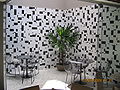
-
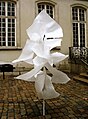
Sarabande Musée des Tissus Lyon 2007-2008
-
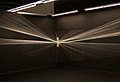
-

La Ferté Bernard Festival Artec 2010
-
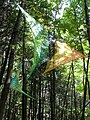
Bois de Belle Rivière Québec 2010
-
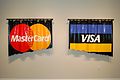
MasterCard/Visa (If information technology wasn't for plastic money I wouldn't have any money at all) Tyler Turkle, 2006, Poured Acrylic, 54 10 43 inches
Run into as well [edit]
- Fine art materials
- Handicraft
- Media (arts)
- Plastic in art
- Visual arts
- Plastic number
- Recording medium
References [edit]
- ^ "Merriam-Webster Online (entry for "plastic arts")". Merriam-webster.com. Retrieved 2011-x-30 .
- ^ Witzel, East. J. Michael (2012). The Origins of the World's Mythologies. Oxford University Press. p. 260. ISBN9780199710157.
Autonomously from rock art, whether engraved, drawn, or painted, there also exist some examples of early sculptures and plastic art (30,000–34,000 bp )
- ^ Russian Romantic Criticism: An Anthology, edited by Lauren Gray Leighton, Published by Greenwood Publishing Group, 1987, ISBN 0313255849, ISBN 978-0313255847
- ^ The literary theories of Baronial Wilhelm Schlegel by Ralph Due west. Ewton jnr, Published by Walter de Gruyter and Co (1972), ISBN 3110991632, ISBN 978-3110991635
- ^ Borough Fine art And then and Now: The Civilisation of Skilful Identify-making past Charles C. Bohl, in Sitte, Hegemann and the Metropolis: Modern Civic Art and International Exchanges, edited past Charles Bohl and Jean-François Lejeune, Published by Routledge, 2009, ISBN 0415424070, ISBN 978-0415424073
- ^ Russian Romantic Criticism: An Anthology, edited by Lauren Grey Leighton, Published by Greenwood Publishing Grouping, 1987, ISBN 0313255849, ISBN 978-0313255847
Further reading [edit]
- Barnes, A. C., The Art in Painting, tertiary ed., 1937, Harcourt, Brace & World, Inc., NY. OCLC 1572753
- Bukumirovic, D. (1998). Maga Magazinovic. Biblioteka Fatalne srpkinje knj. br. 4. Beograd: Narodna knj.
- Fazenda, Thou. J. (1997). Between the pictorial and the expression of ideas: the plastic arts and literature in the dance of Paula Massano. Northward.p.
- Gerón, C. (2000). Enciclopedia de las artes plásticas dominicanas: 1844-2000. 4th ed. Dominican Republic s.northward.
- Schlegel, August Wilhelm., (1966) Vorlesungen uber dramatische Kunst und Literatur, Stuttgart: Kohlhammer Verlag, 1966, p. 21f.
Source: https://en.wikipedia.org/wiki/Plastic_arts#:~:text=Plastic%20arts%20are%20art%20forms,opposed%20to%20literature%20and%20music.
0 Response to "Why Are the Elements of Art Refferred to as the Plastic Elemrnts"
إرسال تعليق