How to Read Cable Ez7 Mathews Cam Bow Video
Video Streaming in Web Browsers with OpenCV & Flask
Streaming live videos from IP Cameras or Webcam with Computer Vision

You took the problem of installing a webcam or a surveillance camera at your abode, or office or any place that you own. Patently, yous would want to exist able to watch the alive stream of the video anyplace and someday you like.
Most of the people use IP cameras (Net Protocol cameras) instead of CCTV (Closed-Circuit Television) for surveillance purposes as they have a much higher resolution and reduced toll for cabling. You can find the detailed differences between both these systems here. In this article we will be focusing on IP cameras.
IP photographic camera, is a blazon of digital video photographic camera that receives control data and sends image information via an IP network and crave no local recording device. Well-nigh IP cameras are RTSP (Real Time Streaming Protocol) based and is therefore "not supported" natively in net browsers.
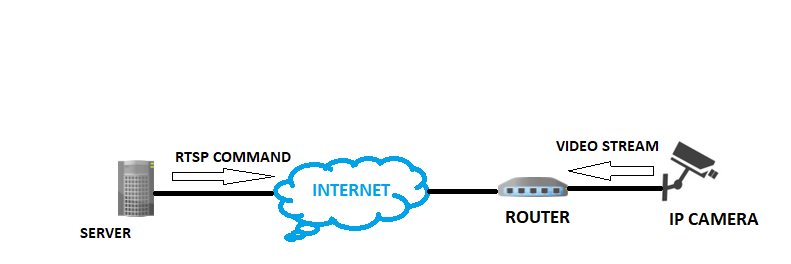
Then how practice you employ your spider web browser to view the live streaming ?
In thi s article nosotros volition learn how to do that using Figurer Vision.
Estimator Vision is an interdisciplinary field that deals with how computers can exist made to proceeds a loftier-level understanding from digital images or videos.
For implementing the reckoner vision part we will use the OpenCV module in Python and to brandish the live stream in the spider web browser we will use the Flask web framework. Earlier diving into the coding part let united states first know well-nigh these modules briefly. If you lot are already familiar with these modules, you tin directly bound to the next section.
According to the Wikipedia, Flask is a micro web framework written in Python. Information technology is classified every bit a microframework because it does not require particular tools or libraries. It has no database abstraction layer, form validation, or any other components where pre-existing tertiary-political party libraries provide common functions.
According to GeeksForGeeks, OpenCV is the huge open up-source library for the figurer vision, machine learning, and image processing and now it plays a major office in real-fourth dimension operation which is very of import in today's systems.
Step1- Install Flask & OpenCV :
You can use the 'pip install flask' and 'pip install opencv-python' command. I use the PyCharm IDE to develop flask applications. To easily install libraries in PyCharm follow these steps.
Step2- Import necessary libraries, initialize the flask app :
We volition now import the necessary libraries and initialize our flask app.
                      #Import necessary libraries
from flask import Flask, render_template, Response
import cv2
            #Initialize the Flask app
app = Flask(__name__)
Step3- Capture Video using OpenCV :
Create a VideoCapture() object to trigger the camera and read the beginning image/frame of the video. We can either provide the path of the video file or utilise numbers to specify the use of local webcam. To trigger the webcam we pass '0' every bit the argument. To capture the alive feed from an IP Camera we provide the RTSP link as the argument. To know the RTSP address for your IP Camera go through this — Finding RTSP addresses.
          photographic camera = cv2.VideoCapture(0)          '''
for ip camera use - rtsp://username:countersign@ip_address:554/user=username_password='password'_channel=channel_number_stream=0.sdp'                    for local webcam use cv2.VideoCapture(0)
'''
Step4- Adding window and generating frames from the camera:
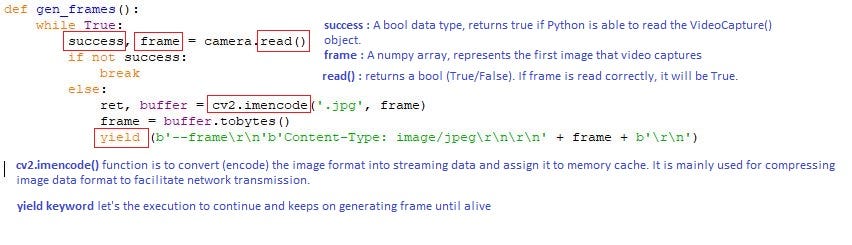
The gen_frames() office enters a loop where it continuously returns frames from the camera as response chunks. The function asks the camera to provide a frame and so it yields with this frame formatted equally a response chunk with a content type of image/jpeg, as shown in a higher place. The code is shown below :
Step5- Define app road for default page of the web-app :
Routes refer to URL patterns of an app (such as myapp.com/abode or myapp.com/nearly). @app.road("/") is a Python decorator that Flask provides to assign URLs in our app to functions easily.
          @app.route('/')
def alphabetize():
            return render_template('index.html')
The decorator is telling our @app that whenever a user visits our app domain (localhost:5000 for local servers) at the given .route(), execute the alphabetize() function. Flask uses the Jinja template library to render templates. In our application, we volition use templates to return HTML which will display in the browser.
Step6- Ascertain app road for the Video feed:
          @app.route('/video_feed')
def video_feed():
            return Response(gen_frames(), mimetype='multipart/x-mixed-replace; boundary=frame')
The '/video_feed' route returns the streaming response. Considering this stream returns the images that are to be displayed in the web page, the URL to this route is in the "src" aspect of the image tag (see 'alphabetize.html' below). The browser will automatically go along the image element updated by displaying the stream of JPEG images in information technology, since multipart responses are supported in most/all browsers
Let'southward accept a look at our index.html file :
          <torso>
<div class="container">
            <div class="row">
            <div class="col-lg-8  offset-lg-ii">
            <h3 class="mt-5">Live Streaming</h3>
            <img src="{{ url_for('video_feed') }}" width="100%">
            </div>
            </div>
</div>
</trunk>
Step7- Starting the Flask Server :
          if __name__ == "__main__":
            app.run(debug=Truthful)
app.run() is called and the web-application is hosted locally on [localhost:5000].
"debug=True" makes sure that we don't crave to run our app every time we makes changes, we can but refresh our web page to see the changes while the server is still running.
Project Structure :
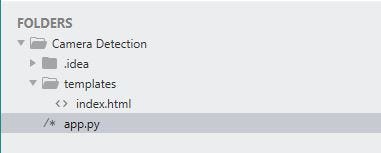
The project is saved in a folder called "Photographic camera Detection". We run the 'app.py' file. On running this file, our application is hosted in the local server at port 5000.
You can simply type "localhost:5000" on your web browser to open your web-awarding after running 'app.py'
- app.py — This is the Flask application we created above
- templates — This binder contains our 'alphabetize.html' file. This is mandatory in Flask while rendering templates. All HTML files are placed under this folder.
Let'south come across what happens when we run 'app.py' :
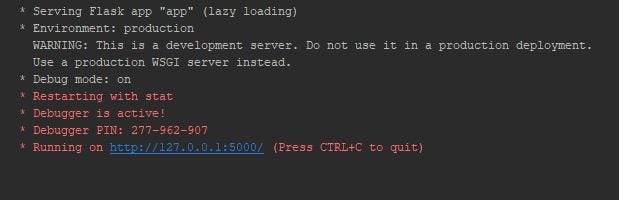
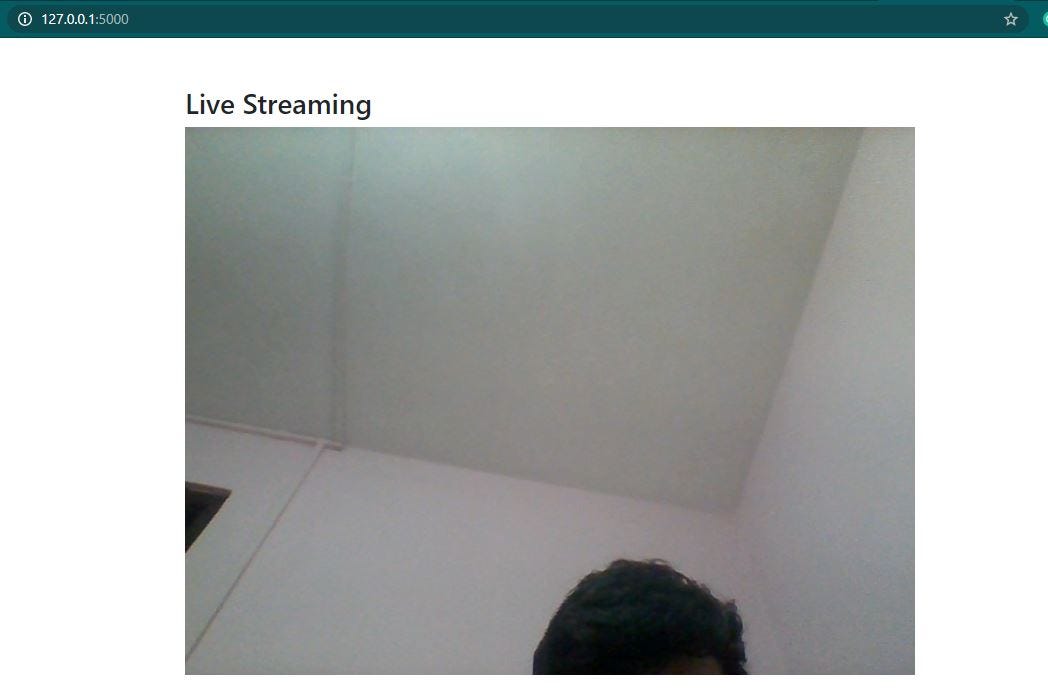
On clicking on the provided URL, our web browser opens up with the alive feed. Since I used VideoCapture(0) above, the webcam feed is displayed on the browser:
I hope this article will get you interested in trying out new things in the Figurer Vision domain and help you add to your knowledge. If you have enjoyed reading this article exercise share information technology with your friends and family. Thank you for your time.
Source: https://towardsdatascience.com/video-streaming-in-web-browsers-with-opencv-flask-93a38846fe00
0 Response to "How to Read Cable Ez7 Mathews Cam Bow Video"
إرسال تعليق